


The word “synagogue” surprisingly comes from Greek, not Hebrew. It refers to gathering together in a group.
The word “synagogue” surprisingly comes from Greek, not Hebrew. It refers to gathering together in a group. In the Bible, we see Jesus and Paul teaching in synagogues that were gathering places for the Jews. Archaeologists have found ruins of ancient synagogues in the Holy Land and in Greece and Italy.
The center of Jewish worship during Jesus’ life and up until 70 A.D. was the temple in Jerusalem. Since the temple was completely destroyed by the Romans there has been no true center of worship for Jews. Their religious practice has moved into their homes, synagogues, and community centers. It looks like ancient synagogues were combinations of places of worship and community centers.
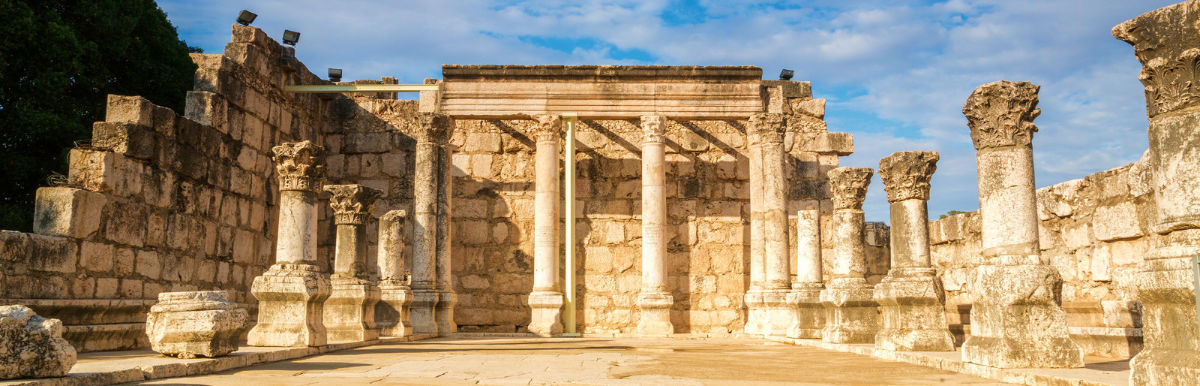
The ruins of ancient synagogues show that they mostly were constructed along the same plan with stepped seats along three walls and a front door facing Jerusalem. In the central room, a person could read from the scriptures while everyone in the congregation could see one another.
Synagogues also had mikvaot—ritual baths for cleansing after times of uncleanness—and places for people to stay, eat, and to gather socially. Sometimes, we read that Jesus healed at a synagogue. We can imagine people naturally gathering there and it being a natural place for Christ to go to heal and teach. It would also be a natural place for Paul and his companions to go and teach. Synagogues were accustomed to receiving travelers and offering them respite and refreshment.